|
THE OLD SCHOOL PRESS
An occasional newsletter about forthcoming
books and events |
|
December 2024 In this newsletter . . . an update on Plates for a Herbal
|
|
THE OLD SCHOOL PRESS
An occasional newsletter about forthcoming
books and events |
|
December 2024 In this newsletter . . . an update on Plates for a Herbal
|
|
progress on Plates for a Herbal |
Work progresses on this new book on the history of printing at Oxford University Press, in particular the printing of the copper engravings for Robert Morison's 1690s Herbal. | |
|
Planned for early 2025 |
| |
|
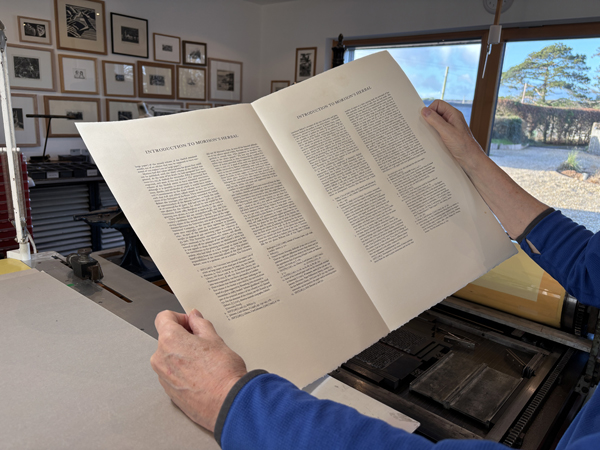
We have fixed a pre-publication price of £350, with the price going to £480 on publication which will be around Easter 2025 (plus shipping in both cases). If you have previously made a firm reservation we will be emailing you, inviting you to lock in the pre-publication price with payment now. If you have not previously made a firm reservation but would like to take advantage of the pre-publication price, please contact us. This week I'm printing the last page of Scott Mandelbrote's introduction to Robert Morison's Herbal, aka Plantarum historiae universalis Oxoniensis, published by Oxford University Press in the 1690s. The original book was printed - as was common at the time - on two different sizes of paper: the main edition on a size known as Lombard, and a 'large paper' edition on a sheet of Royal, in folio. This was largely dictated by the size of the copper plates in the book. In this photo I'm holding an opening of our new book, also a Royal folio, showing two pages of Scott's text.
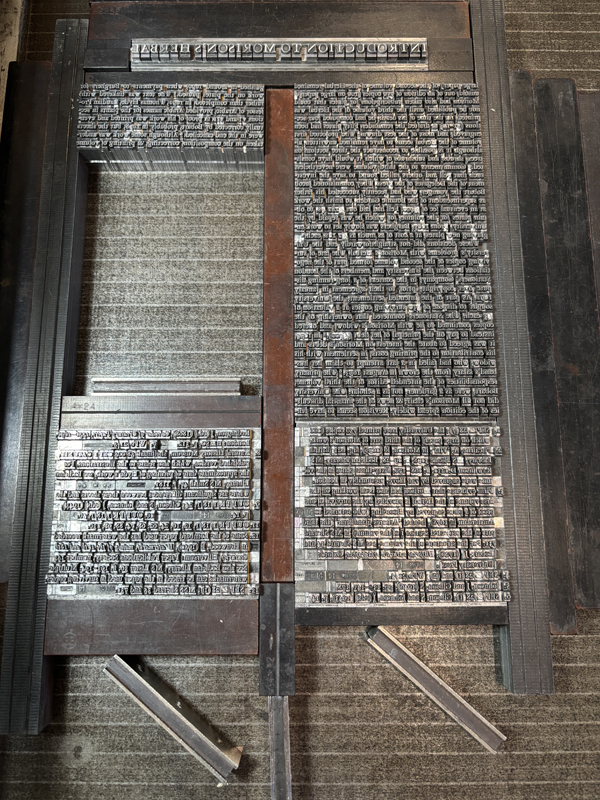
Our new book is printed on a laid paper that originally came from France, a Rives BFK. It's possible that the reams of Royal that the London paper wholesaler John Baskett sold to OUP for the Herbal were also French, but some watermarks suggest that it was from English mills even though they did not have a reputation for quality paper at that time. The two reams of Rives that have gone into our book have an interesting provenance. I rescued them from the defunct printing house of the Carthusian monastery at Parkminster in Sussex some years ago when its contents were sold off - the printing house had been closed for some decades. I also rescued some reams of Renage pres Rives which, I discovered via paper historian Peter Bower, were actually pre-1914, and it's not impossible that our Rives BFK is equally ancient. All the text has been set by hand in Monotype's Van Dijck, a twentieth-century revival based on a type design attributed to Dutchman Christoffel van Dijck, whose son Abraham cut the Small Pica acquired by Bishop Fell for the use of the Oxford printing house in the 1670s and used in Morison's Herbal. I've been setting and printing Scott Mandelbrote's text a page at a time, starting with the footnotes, based on a pretty reliable cast off using my digital mock-up, and hoping that I don't get a problem with long footnotes forcing a tricky decision on where to end a page.
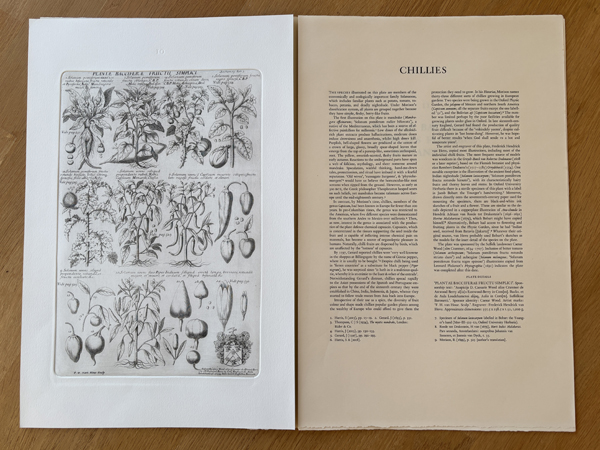
I plan to finish printing by the close of 2024 so that in mid-January all the materials can go north to Ludlow Bookbinders. Those materials include the beautiful engravings that Jim Nottingham has pulled from the original seventeenth-century copper plates, one of which you can see here, placed next to Professor Stephen Harris's text which takes a botanical view of the plate's contents.
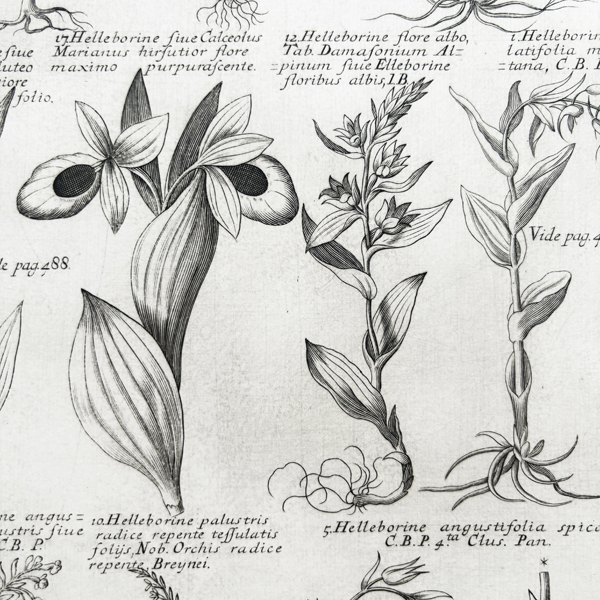
Finally, a reminder of how beautiful these plates are, with a detail from the sheet for orchids:
| ||
|
|
click to see an index of our newsletters
| |
|
Copyright © Martyn Ould 2024 | ||